When Bethesda unveiled the Oblivion Remaster earlier this week, it felt almost surreal. The 2006 journey through Tamriel, once known for its oddly shaped characters and blurry stretches of low-resolution green landscapes, now stands as the most visually stunning Elder Scrolls game to date. Years of HD remasters have taught me to brace for underwhelming updates—titles like Mass Effect Legendary Edition and Dark Souls Remastered barely differ from their Xbox 360 predecessors—so witnessing the Imperial City, a place I explored nearly two decades ago, rendered with Unreal Engine 5 and ray tracing was a shocking, almost unbelievable moment. But the improvements don’t end with graphics: combat, RPG mechanics, and countless other details have also been refined. With so many enhancements, I found myself questioning the label. Shouldn’t this be called Oblivion Remake, rather than a remaster?
As it turns out, I wasn’t alone in that line of thought. Plenty of fans have labeled it a remake, and Bruce Nesmith, the senior designer on the original Oblivion, noted that “the term remaster doesn’t quite capture it.” Initially, I too doubted Bethesda and Virtuos’s choice of words, but after spending several hours playing, the distinction became clear: Oblivion Remastered may boast the look of a remake, yet it unmistakably plays like a remaster.
Why does Oblivion come across as a remake? The reasons are clear and straightforward: Virtuos has undertaken a monumental effort, rebuilding "every single asset from the ground up." Visually, everything you see on screen is entirely new. Every tree, weapon, and ruined fortress has been reimagined, meeting today’s graphical standards. The game features rich textures, stunning lighting, and an advanced physics engine that makes every arrow and strike interact with the environment realistically. While the characters you encounter are the same personalities from 2006, every NPC model has been freshly crafted. This is a comprehensive visual overhaul—not just an attempt to match nostalgic memories, but a genuine effort to make the game look exceptional by 2025 benchmarks. It’s the most impressive a Bethesda RPG has ever appeared, and had I seen it before the remaster rumors surfaced, I might have mistaken it for The Elder Scrolls 6.
The improvements extend beyond the visuals. Combat has been refined so that swinging a longsword no longer feels like fencing with a balloon. The third-person camera is finally practical thanks to the addition of a reticle. Menus—from the quest log to dialogue options, lockpicking, and persuasion minigames—have received modernized interfaces. The original, problematic leveling system has been replaced with a more logical blend of Oblivion and Skyrim’s mechanics. And at long last, you can sprint. With such sweeping upgrades to both look and gameplay, it’s tempting to declare this a remake—but is it?
Had I encountered Oblivion Remastered before the rumors started circulating, I might have believed it was The Elder Scrolls 6.
The core issue here isn’t about technology, scope, or gameplay changes—it’s a matter of semantics. The gaming industry lacks standardized definitions for remasters and remakes, and publishers often use these terms loosely. Rockstar’s "Definitive Edition" remasters of the Grand Theft Auto trilogy are fundamentally PlayStation 2-era games with higher-resolution textures and contemporary lighting. Yet, Crash Bandicoot N. Sane Trilogy, also marketed as a remaster, features entirely new assets and looks like a modern release. The line blurs further with remakes: Bluepoint’s Shadow of the Colossus and Demon’s Souls were rebuilt from scratch, yet remain faithful, nearly one-to-one recreations. Meanwhile, Resident Evil 2 retains the original structure but completely redesigns the player’s interaction with the survival horror classic. Then there are Final Fantasy 7 Remake and Rebirth, which dramatically reimagine the design, script, and story beats of the originals. All five are considered remakes, yet they share little in their approach.
Previously, the consensus suggested that a game rebuilt from the ground up in a modern engine qualified as a remake, while remasters involved more restrained upgrades using the original technology. That distinction is rapidly becoming obsolete. Today, it might be more accurate to define a remaster as a visual uplift that preserves the original design (aside from some quality-of-life improvements), while a remake involves fundamental redesign. Under that definition, Demon’s Souls and the forthcoming Metal Gear Solid: Delta might be recategorized as remasters, reserving the remake title for games that genuinely feel like new interpretations of older concepts.
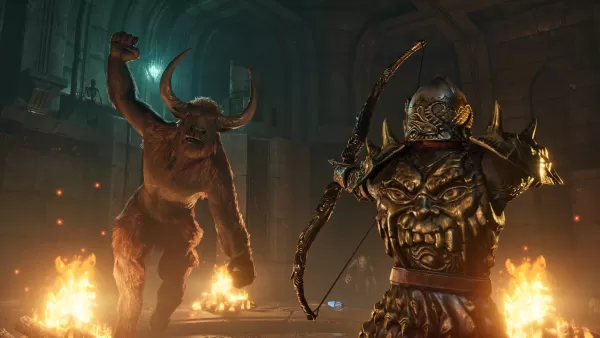
Enhanced lighting, realistic fur, and metallic effects are just the beginning of the upgrades in Oblivion Remastered. Image credit: Bethesda / Virtuos
So where does this new version of Oblivion fit? Based on the definitions above, it’s clear to anyone who’s played even a short session that Oblivion Remastered is aptly named. Yes, its new assets and Unreal Engine 5 ray tracing lend it a fresh appearance, but beneath that radiant surface lies the same 20-year-old framework—a distinctly Bethesda construction held together with creative fixes. As the studio elaborated, “We examined every element and upgraded it thoughtfully. But above all, we never intended to alter the core experience. It remains a game from a past era and should feel like one.”
The fingerprints of that era are everywhere. They’re in the loading screens that appear behind nearly every door. They’re in the bewildering persuasion minigame which, despite a refreshed interface, still feels disconnected from the conversations it accompanies. They’re in the cities, laid out like theater sets rather than intricate, believable population centers. They’re in the NPCs, who move stiffly and speak with the awkward precision of an AI trained on social etiquette guides. They’re in the combat, which, even after meaningful improvements, remains slightly clumsy and detached. And they’re in the long catalog of bugs and glitches, carefully retained to honor the original’s quirky appeal.
The fine details of Oblivion are clearly showing their age.
Not long ago, Obsidian’s Avowed gave us a glimpse into the future of some core Elder Scrolls mechanics. Its responsive combat feels generations ahead of Oblivion Remastered’s, and its approach to rewarding exploration makes Cyrodiil’s rolling hills and murky caves feel like artifacts from another time. These contemporary systems help frame Oblivion Remastered in its proper context. That isn’t to say this revitalized classic has nothing to offer in 2025—far from it. Its world still possesses a captivating magic, with Rohan-like plains brimming with secrets and eccentricities. Many of its ambitious features remain impactful even years later, such as the dynamic conflicts between goblin clans, or the memorable narrative-driven quests that still outshine many of Skyrim’s “clear the draugr-infested dungeon” missions. Its old-school emphasis on player freedom feels refreshing in an era that has moved away from the heavy hand-holding common in 2010s games. Yet the specific mechanics of Oblivion are unmistakably dated. There’s little subtlety in its dialogue, and the way its systems integrate lacks sophistication. Level design—whether in caves, castles, or the twisted planes of Oblivion—feels firmly rooted in the past. A remake would modernize those aspects, but this project is about revisiting the original. Hence: Oblivion Remastered.
Video games have long borrowed terminology from other media. In film, a remake is a complete new production with a fresh cast, crew, script, and sets. A remaster takes an existing movie and enhances it to meet modern visual standards without altering its original character. Classic films like Jaws and The Godfather receive stunning 4K restorations, yet they remain unmistakable products of the 1970s—evident in the direction, acting, and practical effects, right down to the texture of the film grain. Oblivion follows a similar path. It pushes visual fidelity as far as possible, and because video games are a more flexible medium, that means reconstructing the "exterior" in a new engine. Underneath, though, Oblivion is very much a game from the 2000s. Alex Murphy, Virtuos's executive producer, offered a fitting analogy during the announcement stream: "We see the Oblivion game engine as the brain and Unreal 5 as the body. The brain handles the world logic and gameplay, while the body brings to life the experience players have cherished for nearly two decades."
Oblivion Remastered is precisely what it claims to be—and that shouldn’t diminish its accomplishments. Instead of insisting it’s a remake, we should hold it up as the new gold standard for remasters from major AAA studios. This is the kind of treatment Mass Effect Legendary Edition deserved, instead of a polished re-release. This is what Grand Theft Auto: The Trilogy should have been rather than a rushed, cash-in effort. There’s nothing cynical about Oblivion Remastered. It looks like a lovingly crafted remake but preserves the playable soul of a devoted remaster—and that’s exactly as it should be.
The Final CBT is set to launch on June 12th, unveiling the new "Children From the Snowfield" storyline. Secure pre-registration early to unlock exclusive bonus rewards.After months of rigorous playtesting and building anticipation since its initial r
CD Projekt Red has officially confirmed that Cyberpunk 2 (formerly known as Orion) has entered pre-production, as revealed in the studio’s latest financial report. The announcement highlighted the massive success of the Phantom Liberty expansion for
Wuthering Waves version 3.1, part two, has officially launched on iOS and AndroidIt features brand-new five-star resonator convenes and weapon convenesNot to mention new story content featuring additional twists and turnsWith it being a Friday, it se
Calling all Peaky Blinders enthusiasts — we are returning to the Shelby universe. Netflix and the BBC have officially greenlit a two-season order for a sequel series.Set in Britain during 1953, the upcoming show has not yet revealed its casting choi

 LATEST ARTICLES