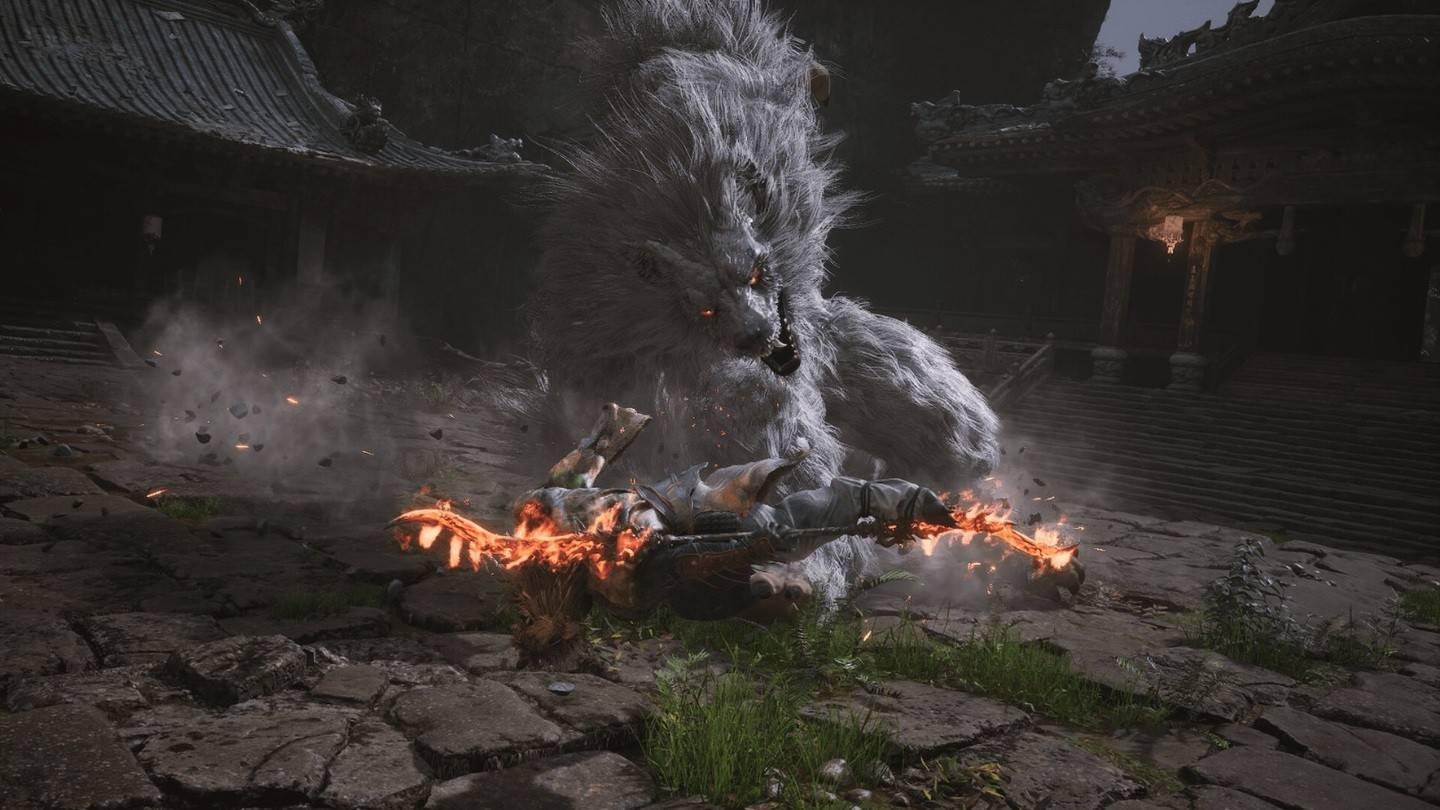
You're highlighting a complex and highly charged situation involving technical claims, developer credibility, and community skepticism—particularly around Black Myth: Wukong’s rumored or unconfirmed Xbox Series S port. Let’s break down the core issues and assess the validity of both the technical argument and the player backlash.
🔍 The Technical Argument: Is the Series S RAM Limitation a Valid Roadblock?
Yes, the hardware constraints are real.
- The Xbox Series S has 10GB of GDDR6 RAM, with 2GB reserved for system functions, leaving ~8GB available for the game.
- This is a known bottleneck, especially for high-fidelity open-world or action-RPG titles like Black Myth: Wukong, which demands:
- High-resolution textures
- Large, dynamic environments
- Complex AI and particle systems
- Real-time rendering of intense boss fights
Game Science (Game Science, the developer) has a track record of pushing graphical fidelity and performance—evident in the game’s stunning tech demo and cinematic trailers. Given that, it’s plausible that the team may have initially assumed a higher level of performance consistency across all Xbox platforms, only to discover during late-stage optimization that the Series S’s limited RAM and bandwidth (compared to Series X) made a smooth, native port unfeasible.
But here’s the key nuance:
Many developers have successfully ported graphically demanding games to Series S.
- Starfield (Bethesda) runs at 1080p/30fps on Series S with optimization patches.
- Indiana Jones and the Great Circle (from the same 2024 TGA era) runs on Series S with up to 60fps in some modes.
- Hellblade II (2024) reportedly uses dynamic resolution scaling and texture streaming to stay within Series S limits.
So, the hardware isn’t incapable—it’s about engineering skill, optimization time, and engine choices.
🤔 Why the Player Backlash? The Root of Distrust
Players aren’t just questioning the tech—they’re questioning credibility, transparency, and team competence.
1. Timeline Inconsistency
"They knew the Series S specs since 2020. Why is this a problem now?"
This is a valid point. The Xbox Series S launched in November 2020. The game was first announced in 2020. That means Game Science had four years to plan for these constraints.
- If the team genuinely believed Series S was a viable target, they should have:
- Designed with variable texture quality, memory budgeting, and LOD (level of detail) strategies from the start.
- Used tools like dynamic resolution scaling, texture streaming, or memory pooling to mitigate constraints.
- The fact that this only emerges now, after multiple years of development and public hype, fuels suspicion.
2. Comparison to Other Games
Players are correct to point out that other AAA titles with higher fidelity have succeeded on Series S. This isn’t about hardware—it’s about execution.
- Starfield didn’t launch on Series S with full fidelity—Bethesda used a patch and optimization effort to get it running.
- Hellblade II uses advanced compression and memory management to stay under 8GB.
That suggests the bottleneck isn’t the console—it’s likely the team’s lack of experience with optimization on low-end hardware, or reliance on a less efficient engine.
3. The Sony Exclusivity Rumor?
- No credible evidence supports a Sony exclusivity deal.
- The game is not confirmed for PlayStation, and Sony has not shown interest.
- This theory appears to stem from paranoia and platform bias, not fact.
- However, it’s worth noting that if Game Science had a deal with Sony, they would likely have announced it—so this is speculative.
4. Is It Developer Complacency?
- Possibly. The team has strong artistic and visual ambition but limited prior experience in large-scale cross-platform development.
- Their engine (proprietary, built for Wukong) may not have the same level of memory management, asset streaming, or profiling tools as Unreal Engine 5 or Unity's modern pipelines.
- That doesn’t excuse it—but it does explain it.
🧩 The Bigger Picture: Why This Matters
-
Player trust is fragile. When a team says “we can’t do it because of hardware,” and fans see other teams doing it with more demanding games, the excuse rings hollow.
-
Transparency is key. If Game Science had said early on:
“We’re prioritizing Series X and PC. Series S may not be viable due to our asset pipeline and engine limitations,”
that would have been more honest.
-
Instead, the strategic ambiguity around Xbox status—while likely a business move—fuels suspicion.
- No official confirmation.
- No timeline.
- No explanation.
This allows fans to interpret silence as deception.
✅ Conclusion: A Mix of Truth and Perception
| Claim |
Verdict |
| Series S has 8GB usable RAM? |
✅ True |
| Can demanding games run on Series S? |
✅ Yes, proven |
| Is it technically possible for Black Myth: Wukong to run on Series S? |
✅ Possibly, but only with heavy optimization |
| Is Game Science’s claim of "hardware limits" a lie? |
❌ Not necessarily. But it lacks credibility due to timing and context |
| Is the real issue developer inexperience/optimization failure? |
✅ Very likely |
| Is the Sony exclusivity theory valid? |
❌ No evidence; likely conspiracy thinking |
🎮 Final Takeaway
The hardware isn’t the villain. The lack of optimization expertise, delayed planning, and poor communication are.
Game Science may be facing a real technical challenge, but their failure to address it early, combined with overpromising on cross-platform availability, has eroded trust. Players aren’t angry because of RAM limits—they’re angry because they feel misled.
For future credibility:
- The team should release a detailed dev blog explaining:
- Why optimization is so difficult.
- What engine limitations exist.
- How they’re handling memory and streaming.
- Or, if they truly can’t deliver on Series S, say so clearly:
"We’ve explored every path. The engine, art pipeline, and performance targets make a Series S port unworkable without compromising the game’s vision."
Only then can the community separate technical reality from perceived excuses.
Until then, the skepticism isn’t baseless—it’s a rational response to years of ambiguous messaging and a sudden, unconvincing roadblock.

 Derniers articles